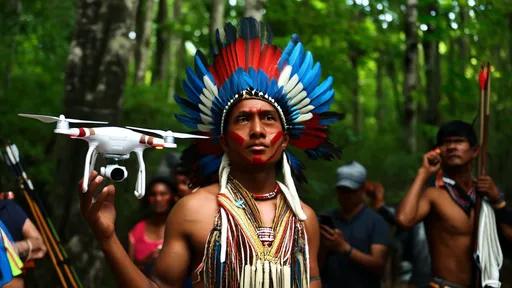
Deep in the heart of the Amazon rainforest, where the emerald canopy stretches endlessly and rivers carve ancient paths through the land, a quiet revolution is unfolding. Indigenous tribes, long portrayed as disconnected from modernity, are now harnessing cutting-edge technology to defend their ancestral territories. Drones buzz overhead, capturing footage of illegal logging and land invasions, while smartphones document environmental crimes in real-time. This is not a scene from a dystopian novel—it’s the new frontline of Indigenous resistance.
The Munduruku people, one of the largest Indigenous groups in the Brazilian Amazon, have become unlikely pioneers in this tech-driven movement. For generations, their struggle against deforestation and industrial encroachment relied on foot patrols and word-of-mouth alerts. But as threats escalated—with illegal miners, loggers, and agribusinesses exploiting weakened environmental protections—their tactics evolved. "We realized we needed eyes in the sky," explains Alessandra Korap, a Munduruku leader. "The invaders move fast, but now we move faster."
Their weapon of choice? A fleet of drones donated by international NGOs and operated by young tribal members trained in aerial mapping. These devices capture high-resolution images of deforested areas, which are then geotagged and timestamped to create irrefutable evidence for legal actions. The footage has been instrumental in lawsuits against mining companies and land grabbers, some of which have resulted in rare victories for Indigenous rights. "When we show the judges videos of our sacred trees being cut down, they can no longer pretend it’s not happening," says Korap.
Beyond documentation, technology has become a tool for global storytelling. The Yanomami tribe, whose territory spans Brazil and Venezuela, uses solar-powered satellite internet to livestream environmental destruction to international audiences. A recent broadcast showing mercury-polluted rivers—a byproduct of illegal gold mining—sparked outrage across social media, pressuring authorities to launch investigations. "The world needs to see what’s happening here," says Davi Kopenawa, a Yanomami shaman. "We may live in the forest, but we’re connected to everyone now."
This digital resistance comes at a critical juncture. Under Brazil’s previous administration, deforestation rates soared to a 15-year high, with over 13,000 square kilometers of Amazon rainforest lost in 2021 alone. Indigenous territories, which account for nearly a quarter of the Brazilian Amazon, have become the last bastions of intact ecosystems. Studies show that deforestation rates are significantly lower in Indigenous-protected areas compared to surrounding regions. "We’re not just fighting for our land," emphasizes Txai Suruí, a 25-year-old activist from the Paiter Suruí tribe. "We’re fighting for the planet’s future."
The technological transition hasn’t been seamless. Some elders initially viewed drones as disruptive "metal spirits," while unreliable electricity and internet access in remote villages pose ongoing challenges. Yet the benefits outweigh the hurdles. Workshops led by Indigenous tech collectives teach coding and data analysis, empowering communities to interpret satellite imagery themselves rather than relying on external experts. "This knowledge belongs to us now," says Suruí, who helped develop an app mapping illegal mining sites. "We decide how to use it."
International allies have amplified these efforts. The Amazon Conservation Team, a nonprofit, provides drones and training while respecting Indigenous leadership. "Our role isn’t to direct but to support," explains program director Vasco van Roosmalen. Meanwhile, the Coordinating Body of Indigenous Organizations of the Amazon Basin (COICA) launched a real-time monitoring platform combining drone footage with NASA satellite data. This fusion of traditional knowledge and space-age tech creates what van Roosmalen calls "an unbreakable chain of evidence."
Critics argue that technology distracts from core issues like land titling and political representation. Some government officials have even accused tribes of "playing with toys" instead of negotiating. Indigenous leaders counter that their sovereignty begins with the ability to monitor their own lands. "They call our drones toys while their bulldozers are the real weapons," retorts Korap during a congressional hearing, holding up a drone fragment damaged by gunfire—proof of escalating violence against forest guardians.
The movement’s ripple effects extend beyond the Amazon. In Indonesia, the Dayak tribe employs similar drone tactics against palm oil expansion. Canadian First Nations use thermal imaging drones to track wildlife declines. This global network of Indigenous technologists shares strategies through encrypted channels, creating what anthropologist Felipe Milanez terms "a decentralized firewall against ecological collapse." The Munduruku’s drone manuals, translated into over a dozen Indigenous languages, have become unexpected bestsellers in environmental circles.
As sunset paints the Amazon in gold and violet hues, a Munduruku drone operator lands his device after a surveillance flight. The footage reveals fresh tire tracks heading toward protected areas—tomorrow’s patrol route. Nearby, children crowd around a tablet, studying the images with practiced eyes. Their grandfather, a village elder who once fought with bows and arrows, nods approvingly. "Different tools, same war," he murmurs. In this ancient forest, the future of environmental resistance is being rewritten—one pixel at a time.

By /Jun 10, 2025

By /Jun 10, 2025

By /Jun 10, 2025

By /Jun 10, 2025

By /Jun 10, 2025

By /Jun 10, 2025

By /Jun 10, 2025

By /Jun 10, 2025

By /Jun 10, 2025

By /Jun 10, 2025

By /Jun 10, 2025

By /Jun 10, 2025

By /Jun 10, 2025
By /Jun 10, 2025
By /Jun 10, 2025

By /Jun 10, 2025

By /Jun 10, 2025
By /Jun 10, 2025

By /Jun 10, 2025

By /Jun 10, 2025