The concept of using quantum entanglement to transmit information has long captured the imagination of scientists and science fiction enthusiasts alike. The idea that particles could be linked across vast distances, instantly influencing one another, seems to promise a revolution in communication. However, the reality is far more nuanced—and often misunderstood.
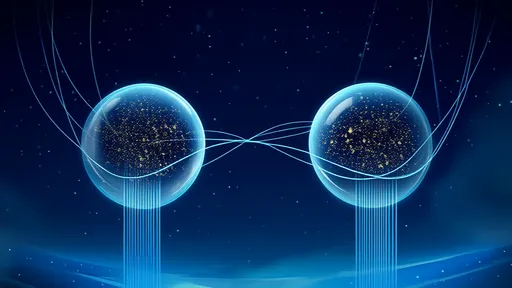
Quantum entanglement is a well-documented phenomenon in which two or more particles become correlated in such a way that the state of one instantly influences the state of the other, no matter how far apart they are. This "spooky action at a distance," as Einstein famously called it, appears to defy classical notions of locality and causality. Yet, despite its strange and seemingly instantaneous nature, quantum entanglement cannot be used to send information faster than light—a fact that often surprises those unfamiliar with the deeper mechanics of quantum theory.
The confusion arises from a misinterpretation of what entanglement actually allows. When two particles are entangled, measuring one immediately determines the state of the other. However, the outcome of that measurement is entirely random from the perspective of an observer. Without prior knowledge of the initial entangled state, the recipient of the "message" cannot decode any meaningful information from the measurement alone. In other words, while entanglement creates a correlation, it does not provide a mechanism for controlled, faster-than-light communication.
Why does this matter? The misconception that quantum entanglement enables superluminal communication has led to numerous speculative claims, from instant interstellar messaging to unhackable quantum networks operating beyond the speed of light. While quantum technologies do hold immense potential—quantum cryptography being a prime example—they are bound by the same fundamental limits imposed by relativity. Information, as we currently understand it, cannot travel faster than light without violating causality, a principle that remains unchallenged by entanglement.
Researchers have spent decades exploring the boundaries of quantum communication, and while breakthroughs like quantum teleportation (which relies on entanglement) have been achieved, they still require classical communication channels to function. This means that even in the most advanced quantum systems, information transfer remains constrained by the speed of light. The true power of entanglement lies not in breaking cosmic speed limits but in enabling secure communication and unprecedented computational capabilities.
Another layer of complexity comes from the no-cloning theorem, a fundamental result in quantum mechanics that states it is impossible to create an identical copy of an arbitrary unknown quantum state. This theorem further restricts the possibility of using entanglement for information transmission, as it prevents the amplification or replication of quantum signals in the way classical signals can be boosted over long distances.
Despite these limitations, the study of quantum entanglement continues to yield astonishing insights. Experiments have confirmed its non-local nature, and applications in quantum computing and cryptography are already taking shape. The dream of a "quantum internet" is not about faster-than-light emails but rather about leveraging entanglement for ultra-secure data transfer and distributed quantum processing.
The takeaway? Quantum entanglement is one of the most profound and mysterious phenomena in physics, but it is not a magic bullet for instantaneous communication. The reality is both more constrained and more fascinating than the myths suggest. As research progresses, the true potential of entanglement will likely emerge in ways that respect the fundamental laws of the universe—while still pushing the boundaries of what we once thought possible.
By /Jun 7, 2025

By /Jun 7, 2025

By /Jun 7, 2025

By /Jun 7, 2025

By /Jun 7, 2025

By /Jun 7, 2025

By /Jun 7, 2025

By /Jun 7, 2025

By /Jun 7, 2025

By /Jun 7, 2025
By /Jun 7, 2025

By /Jun 7, 2025

By /Jun 7, 2025

By /Jun 7, 2025
By /Jun 7, 2025
By /Jun 7, 2025
By /Jun 7, 2025

By /Jun 7, 2025

By /Jun 7, 2025
By /Jun 7, 2025