The concept of a space elevator, once relegated to the realm of science fiction, has steadily inched toward the fringes of scientific plausibility. For decades, the idea of a towering structure connecting Earth to space has captivated imaginations, offering a vision of cheap, efficient access to orbit. But how close are we to turning this fantastical notion into reality? The answer lies at the intersection of material science, engineering audacity, and economic feasibility.
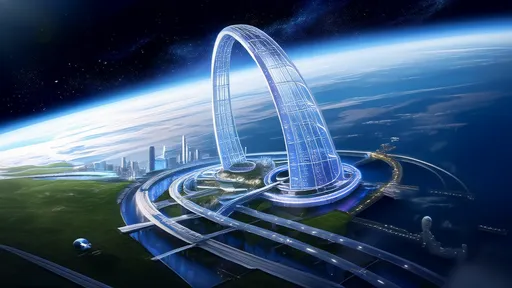
The space elevator, as envisioned, would consist of a cable anchored to the Earth's surface, extending tens of thousands of kilometers into space, with a counterweight at the far end to keep it taut. Climbers—mechanical devices—would ascend and descend this cable, transporting cargo and possibly humans into orbit without the need for rockets. The advantages are clear: reduced costs, decreased reliance on fossil fuels, and the potential to revolutionize space travel. Yet, the challenges are equally daunting.
Material science stands as the most formidable hurdle. The cable, or tether, would need to withstand unimaginable stresses—tensile forces from Earth's gravity, centrifugal forces from the counterweight, and the constant threat of micrometeoroid impacts. For years, scientists believed no known material could meet these demands. Then came carbon nanotubes, with their extraordinary strength-to-weight ratio. Theoretical calculations suggested they might be up to the task, but manufacturing them at the required scale and purity remains a distant dream. Even the strongest carbon nanotubes produced today are mere centimeters in length, far short of the thousands of kilometers needed.
Beyond materials, engineering challenges loom large. The tether would need to be precisely balanced, with its center of mass in geostationary orbit to maintain stability. Any imbalance could send the entire structure careening out of control. Weather poses another threat: hurricanes, lightning strikes, and high-altitude winds could all jeopardize the elevator's integrity. And then there's the issue of space debris—orbital junk traveling at hypersonic speeds could sever the tether with a single impact.
Economic and political considerations add further complexity. Building a space elevator would require unprecedented international cooperation, as the structure would span national boundaries and airspace. The cost, estimated in the tens of billions of dollars, would demand both public and private investment. Skeptics argue that the funds might be better spent on improving existing rocket technology, which has seen significant advancements in recent years thanks to companies like SpaceX and Blue Origin.
Despite these obstacles, research continues. Organizations like the International Space Elevator Consortium and Japan's Obayashi Corporation have published detailed plans, with the latter claiming it could build a space elevator by 2050. NASA has funded studies on the concept, and private startups are exploring niche applications, such as lunar space elevators that would face fewer technical challenges due to the Moon's weaker gravity.
The dream of a space elevator persists because the rewards are so tantalizing. If realized, it could slash the cost of sending payloads into space from thousands of dollars per kilogram to mere hundreds. This would open the door to large-scale space industrialization, asteroid mining, and even the construction of orbiting habitats. The environmental benefits could be substantial, too, as rocket launches are notoriously polluting.
For now, the space elevator remains a vision on the horizon—a symbol of what humanity might achieve if it can overcome the limits of current technology. While the challenges are immense, history has shown that today's science fiction often becomes tomorrow's reality. Whether the space elevator follows that path depends on breakthroughs yet to come and the collective will to pursue them.
In the meantime, the idea continues to inspire. It serves as a reminder that the boundaries of human ingenuity are not fixed, and that the line between fantasy and feasibility is always shifting. The space elevator may not be imminent, but its very possibility pushes us to think bigger, to imagine a future where the sky is not the limit, but the beginning.
By /Jun 7, 2025

By /Jun 7, 2025
By /Jun 7, 2025
By /Jun 7, 2025

By /Jun 7, 2025
By /Jun 7, 2025

By /Jun 7, 2025

By /Jun 7, 2025
By /Jun 7, 2025

By /Jun 7, 2025

By /Jun 7, 2025

By /Jun 7, 2025

By /Jun 7, 2025
By /Jun 7, 2025
By /Jun 7, 2025
By /Jun 7, 2025
By /Jun 7, 2025

By /Jun 7, 2025
By /Jun 7, 2025
By /Jun 7, 2025