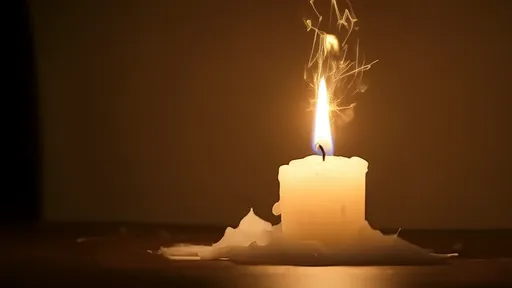
The humble candle flame, a companion to humankind for centuries, holds secrets far more complex than its flickering light suggests. What appears as simple combustion to the naked eye is in fact a sophisticated chemical reactor operating at the nanoscale - a veritable factory producing molecules we're only beginning to understand.
The Flame as Chemical Crucible
When a candle burns, the process involves over 200 different chemical reactions occurring simultaneously across temperature gradients that range from 300°C near the base to 1400°C at the tip. The yellow luminosity we associate with candlelight comes from incandescent soot particles undergoing continuous formation and destruction - a dynamic dance of carbon molecules assembling and disassembling in fractions of a second.
Recent studies using advanced spectroscopy and mass spectrometry have revealed that the flame acts as an efficient nanomaterial factory. The extreme temperature variations and radical-rich environment create perfect conditions for molecular self-assembly. Polycyclic aromatic hydrocarbons (PAHs) form intricate carbon structures that later coalesce into the soot particles visible to our eyes.
The Hidden Production Line
Three distinct zones in the candle flame function like specialized departments in a manufacturing plant. The dark inner cone is where wax vaporizes and begins breaking down into smaller hydrocarbons. The luminous middle zone serves as the main reaction chamber where most molecular construction occurs. The faint outer blue zone completes combustion, but not before some molecules escape this final "quality control" stage.
What makes this process remarkable is its precision at the nanoscale. The same carbon atoms that might form simple carbon dioxide if completely burned can instead assemble into fullerenes (buckyballs), graphene fragments, and even carbon nanotubes under the right flame conditions. Researchers have identified at least 15 different nanostructures forming spontaneously in candle flames.
Nature's Efficient Assembly Line
The flame's chemistry demonstrates principles of green manufacturing that human engineers struggle to replicate. It uses ambient air as both reactant and transport medium, requires no toxic solvents, and generates its own thermal energy to drive reactions. The entire system self-regulates, adjusting reaction pathways based on temperature and oxygen availability.
Perhaps most astonishing is the flame's ability to build complex molecules from simple precursors. The paraffin wax (typically C₂₅H₅₂) first breaks into smaller fragments like ethylene and acetylene. These then recombine through radical reactions into larger structures, with the flame's gradients ensuring each reaction occurs in its optimal temperature zone.
Unexpected Products
Beyond the expected combustion products (CO₂, H₂O), candle flames produce an array of surprising molecules. Mass spectrometry has detected everything from carbon clusters resembling interstellar dust to oxygenated compounds similar to those found in atmospheric aerosols. Some researchers speculate that candle burning may mimic certain prebiotic chemical processes that occurred on early Earth.
The soot particles themselves, long considered simple aggregates of carbon, turn out to have intricate architectures when examined with electron microscopy. Many exhibit onion-like layered structures or graphitic domains with varying degrees of crystallinity. Their surfaces often contain functional groups that make them surprisingly reactive despite their carbon-rich composition.
Implications for Nanotechnology
Materials scientists are now looking to candle flames for inspiration in nanomaterial production. Traditional methods for creating fullerenes or carbon nanotubes often require expensive equipment, vacuum conditions, or toxic catalysts. Flame synthesis offers a potentially simpler, scalable alternative if the right conditions can be controlled.
Several research groups have already demonstrated the ability to "tune" candle-like flames to favor specific nanostructures. By adjusting parameters like oxygen content, fuel composition, or temperature profiles, they can shift production toward graphene flakes, carbon dots, or other desirable nanomaterials. The challenge lies in achieving sufficient yield and purity for commercial applications.
Ancient Technology, Modern Mysteries
Despite centuries of candle use and decades of combustion research, the full complexity of candle flame chemistry continues to surprise scientists. Only in the last 15 years have analytical techniques become sensitive enough to detect many of the short-lived intermediates and trace products. Each new study seems to uncover additional reaction pathways and molecular products.
This everyday phenomenon serves as a reminder that nature often conceals profound complexity beneath apparent simplicity. The candle flame, often relegated to romantic metaphor or emergency lighting, stands as one of the most accessible yet chemically rich systems in our daily experience - a nano-factory operating in plain sight, its full potential still glowing with possibility.
By /Jun 7, 2025

By /Jun 7, 2025

By /Jun 7, 2025

By /Jun 7, 2025

By /Jun 7, 2025

By /Jun 7, 2025

By /Jun 7, 2025

By /Jun 7, 2025

By /Jun 7, 2025

By /Jun 7, 2025
By /Jun 7, 2025

By /Jun 7, 2025

By /Jun 7, 2025
By /Jun 7, 2025
By /Jun 7, 2025
By /Jun 7, 2025

By /Jun 7, 2025

By /Jun 7, 2025
By /Jun 7, 2025

By /Jun 7, 2025