The race to synthesize element 119, the next frontier in the periodic table, has ignited a fierce competition among the world's leading nuclear research laboratories. As scientists push the boundaries of atomic physics, this elusive superheavy element represents not just a scientific milestone but also a matter of national prestige. The stakes are high, and the challenges are monumental, requiring unprecedented technological innovation and international collaboration.
The Quest for the Unknown
For decades, the periodic table has been expanding as researchers discovered new elements by smashing atomic nuclei together at incredible speeds. The synthesis of element 118, oganesson, in 2002 marked the completion of the seventh row. Now, the scientific community is fixated on the eighth row, where element 119 would reside. Unlike its predecessors, this element would belong to an entirely new period, potentially exhibiting exotic properties that defy current theoretical predictions.
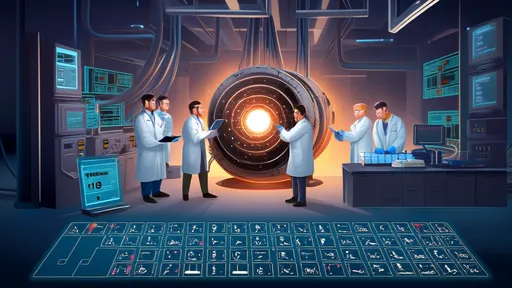
Leading the charge are three powerhouse institutions: the Joint Institute for Nuclear Research (JINR) in Dubna, Russia; RIKEN in Japan; and the GSI Helmholtz Centre for Heavy Ion Research in Germany. Each brings unique capabilities to this high-stakes endeavor. The JINR team, famous for its discovery of multiple superheavy elements, plans to use a calcium-48 beam to bombard a berkelium target. Meanwhile, RIKEN's Nishina Center is preparing an ambitious vanadium-51 and curium-248 collision experiment. The GSI, with its upgraded FAIR facility, is exploring titanium-50 and einsteinium-254 combinations.
Technological Hurdles and Breakthroughs
The synthesis of element 119 presents extraordinary technical challenges. The target materials themselves are incredibly rare - einsteinium-254, for instance, exists in quantities measured in micrograms worldwide. Beam intensities must be orders of magnitude higher than previous experiments to compensate for the dramatically lower production probabilities. Detection systems need unprecedented sensitivity to identify perhaps just a single atom among billions of unwanted nuclear reactions.
Recent advancements in accelerator technology and detection methods have given researchers new hope. The development of gas-filled recoil separators and next-generation silicon detector arrays allows for better isolation and identification of superheavy nuclei. Cryogenic techniques now enable longer experiments by preventing target materials from disintegrating under intense ion beams. These innovations are crucial when production cross-sections are predicted to be in the femtobarn range (10^-39 cm²) - meaning scientists might need to run experiments continuously for months or even years to have a chance at success.
Theoretical Implications and Predictions
The potential discovery of element 119 could revolutionize our understanding of atomic structure. Current relativistic quantum calculations suggest it might be the first element in a new "island of stability," where superheavy nuclei could have significantly longer half-lives than their lighter counterparts. Some theories propose that electron orbitals in these massive atoms might behave in completely unexpected ways, possibly leading to new chemical properties that challenge the periodic table's established patterns.
However, not all predictions are optimistic. Competing models indicate that the "island" might be further out, or that element 119 could be so unstable as to decay within microseconds. The very definition of an "element" comes into question when dealing with nuclei that might exist for such brief moments. These theoretical debates add another layer of excitement to the experimental race, as the discovery could validate or overthrow decades of nuclear models.
International Collaboration and Rivalry
While the competition is intense, the scale of the challenge has fostered unprecedented international cooperation. The supply of rare target materials often requires collaboration between nations, as no single country possesses all necessary resources. American laboratories provide critical isotopes, while European and Asian facilities contribute technical expertise. This delicate balance between competition and cooperation highlights the unique nature of fundamental scientific research.
The recognition of discovery also presents complex diplomatic questions. The International Union of Pure and Applied Chemistry (IUPAC) must verify any claim, a process that can take years. The naming rights carry significant cultural weight - will element 119 honor a scientist, a location, or represent some aspect of its properties? Past naming controversies, such as those surrounding elements 113 (nihonium) and 118 (oganesson), suggest the decision will be closely watched worldwide.
Beyond the Laboratory: Implications for Science
The pursuit of element 119 extends far beyond checking a box on the periodic table. The technologies developed for these experiments find applications in medicine, materials science, and even quantum computing. The extreme conditions created during synthesis attempts provide valuable data about nuclear forces under conditions never before studied. Each failed attempt still contributes to our understanding of nuclear physics, helping refine theoretical models.
Perhaps most importantly, this quest captures the public imagination, inspiring future generations of scientists. The periodic table remains one of the most recognizable symbols of science, and its expansion demonstrates humanity's relentless curiosity about the fundamental building blocks of our universe. Whether element 119 is discovered next year or decades from now, its pursuit represents science at its most ambitious and collaborative.
As laboratories around the world prepare their next round of experiments, the scientific community holds its collective breath. The synthesis of element 119 would mark a new chapter in our understanding of matter. While the challenges are immense, the potential rewards - both in knowledge and technological spin-offs - make this one of the most exciting frontiers in modern physics. The periodic table's next blank spot awaits its conqueror.
By /Jun 7, 2025

By /Jun 7, 2025

By /Jun 7, 2025

By /Jun 7, 2025

By /Jun 7, 2025

By /Jun 7, 2025

By /Jun 7, 2025

By /Jun 7, 2025

By /Jun 7, 2025

By /Jun 7, 2025
By /Jun 7, 2025

By /Jun 7, 2025

By /Jun 7, 2025

By /Jun 7, 2025
By /Jun 7, 2025
By /Jun 7, 2025

By /Jun 7, 2025

By /Jun 7, 2025
By /Jun 7, 2025

By /Jun 7, 2025